
Investors dream of the day that they will hear about the next big opportunity BEFORE it becomes popular. Wistfully, they consider how different things would be if they had bought stock in Microsoft, Google, or Berkshire-Hathaway in the earliest days when those companies became publicly traded.
Alas, it's rare for investors to hear about such opportunities before they become big. That's why we at MetalsNews try to find those burgeoning just-about-to-list companies or just-listed companies and we present them to investors to consider whether or not they will become the next big thing.

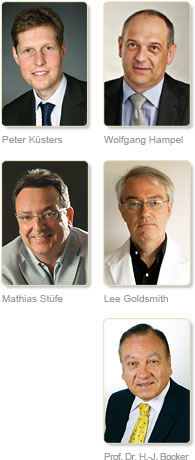
Recently, we had a chance to talk to Wolfgang Hampel, the COO of a company incorporated in 2008 called Tantalus Rare Earths AG. This company was founded in Germany and is headed by CEO Peter Kusters, an attorney-at-law. While Mr. Kusters provides the overarching vision, Wolfgang Hampel is the voice of experience. He is a geologist with over two decades of experience in the field, leading mining and exploration firms around the world. Primarily, Hampel's experience has been in Africa and his work has been in gold and base metals exploration and then in rare earths exploration. Today, Mr. Hampel is on the executive team of Tantalus. "As the COO, I'm in charge of the technical aspects of the company – geology and exploration." Later, he said, "We're a young company and have just listed on the Frankfurt Stock exchange under the trading Code “TAE," says Mr. Hampel.
Tantalus Rare Earths has an interesting vision. They understand that China is producing most of the rare earth elements that are in the world right now and so their mission, according to their website, "is the identification and development of resource projects outside China, mainly focused on Africa."
Their major project (currently their only project, although they are actively looking for additional properties) is located in Madagascar, the fourth largest island in the world, located off the Southeastern coast of Africa. Madagascar has been ruled by Middle Eastern Muslims, pirates, and the French, and in 1960 the Republic of Madagascar became independent from France. Mining is growing in importance in Madagascar, with ilmenite and chromitel as two of the larger mining operations in the country.
Rare earths are used in the following applications:
Catalysts for automobiles, chemical and petroleum industry
Key components for clean energy technologies
Manufacture of glass polishing agents and ceramics
Manufacture of special fertilizers
Technical spark ignition systems
Manufacture of toys and electronic devices
Production of phosphors for screens
Space-related applications as well as the entire aerospace spectrum
Defense industry
Permanent magnets, super conductors, high tech alloys
It is in this context that Tantalus is developing its first property, the Tantalus REE-Ta-Nb-Zr-Hf-U project situated on the Ampasindava Peninsula in northern Madagascar. This property is at an advanced exploration phase and is ready to be drilled. The central 2 km long mineralization is estimated to contain a non-NI43-101 compliant resource of 15 million tons @ 1.52 % REE equivalent with an in ground value of approximately 1.477 billion USD. "The mineralization itself has been known for decades but in the past it was only explored for alluvial cassiterite and pyrochlore and then in late 1980's and early 1990's there was a fair amount of geological work concentrating on a small part of our concession area and they did a lot of surface work. Later in the 1990's there was quite a bit of political turmoil in Madagascar so everything stopped. No one wanted to explore there because the political situation was bad. This changed in 2001 and 2002 when the World Bank started a new project to reform the mining system in the country to make it friendlier for investors. An Australian company picked up this ground and then we bought it ."
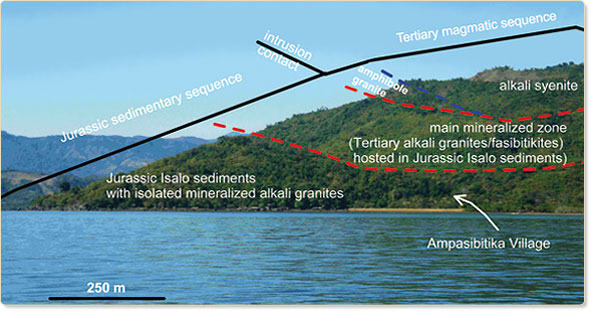
The main part of the 300 km² sized concession area is underlain by two contiguous Tertiary alkaline ring complexes which intruded into Jurassic sediments. The main REE mineralization concentrates along the contact between sediments and intrusives. It consists of late magmatic alkaline granites and associated REE skarns. The alkaline granites form multiple parallel vein systems which reach between 3 and 8 m in thickness. At least five of these vein systems occur within a 50 to 200 m wide zone. The majority of the veins dip with 15 to 45° towards the center of the intrusion. In the western part of the concession there are indications for bulk, non-vein hosted REE mineralization plus possibly REE bearing clays.
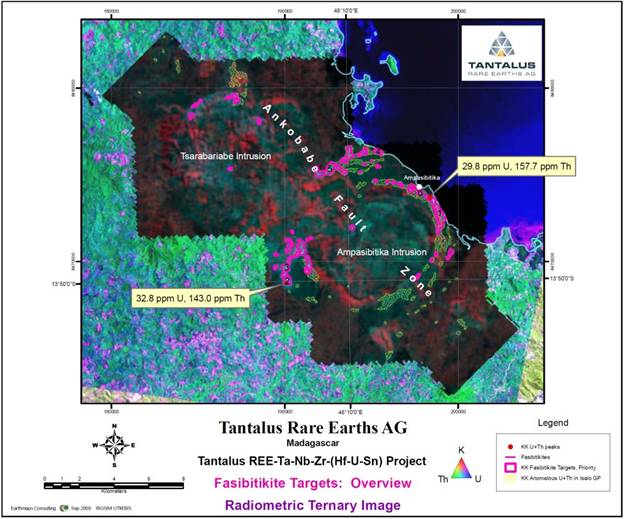
Following figure: Radiometric ternary image showing the main anomalous zones (purple/yellow), outcropping REE mineralization has been confirmed over almost 20 km strike length.
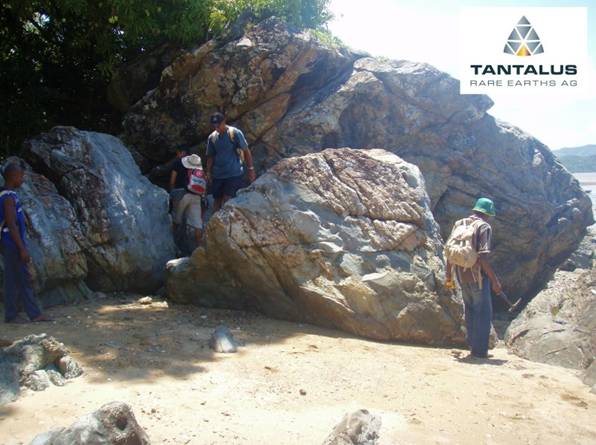
Following figure: massive REE mineralized ore boulders lying on the beach in the eastern part of the concession.
This investment from such a young company turned out to be really good news. Mr. Hampel describes the impressive discovery that Tantalus made: "We did a high precision helicopter borne radiometric and magnetic survey which confirmed that the [radiometric] anomalies were much, much bigger than originally anticipated."
"We have a very good geological team down in Madagascar… and we've hired two senior geologists in Canada and in Europe to help us."
With such a find in the exciting rare earths sector of the mining industry, Tantalus presents an interesting opportunity for investors. They are listed on the Frankfurt Exchange since 11th of January 2010, giving investors a "ground floor" opportunity to invest. The international ISIN code of the shares are DE000A0SMSL4.
Why should investors look at such a young company? Mr. Hampel has an easy answer: "One of the biggest advantages of our project is the sheer size of the anomaly. There aren't many companies with a 30 kilometer long anomaly with outcropping mineralization for almost 20 km. This length of anomaly and the established infrastructure [of the project area] are excellent advantages."
Following figure: Schematic geological cross section through the main prospect
Every company has challenges and it would be naïve to think otherwise. Mr. Hampel describes their biggest challenge is the size of the anomaly. "It's not easy to pick out the best part immediately. It's impossible to drill over 30 kilometers in the first year but we're going to put in a massive drilling program – a minimum 20,000 meters to 40,000 meters in 2010." In terms of capital, Mr. Hampel says they are adequately funded: "We are fully financed in 2010 for the drilling program; we're comfortable."
So, what's in store for the company? Aside from being the first listing on Frankfurt in 2010, as well as a large drilling operation throughout the year, the company has a growth program they're pursuing: "For the time being, this is our only property but we are actively looking for more properties elsewhere." They are looking specifically for "rare earth properties, amenable to open pit mining, no matter where they are in the world."
Obviously, every investor needs to do their own due diligence to make sure that a company is right for them. However, investors who are looking to get in on the ground floor of a brand new company with some interesting possibilities in a sector that has lots of opportunity ahead, Tantalus Rare Earths AG could be an interesting investment….
References
Tantalus Rare Earths AG http://www.tre-ag.com